

MSME Feature: Keorapetse Tshepe (Pty) Ltd – Photography
February 20, 2026
MSME Feature: UniAppSA
March 5, 2026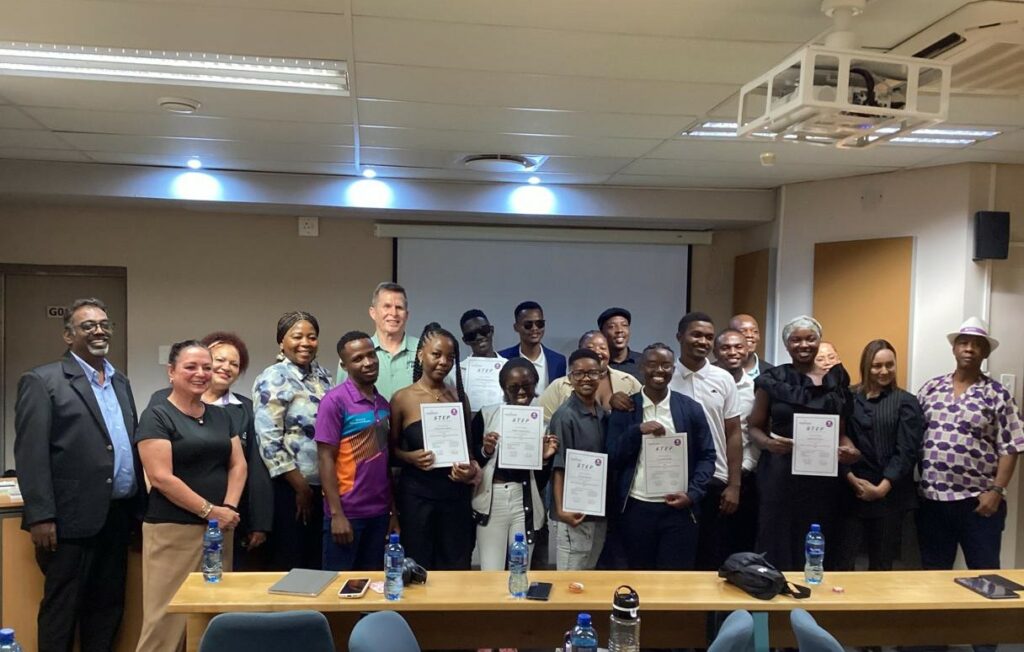
NWDC supports NWU Entrepreneurial Awards Ceremony
The North-West University’s Mahikeng Campus was buzzing with excitement and celebration on 2 March 2026 as students, staff, partners, and supporters gathered for the annual Student Training for Entrepreneurial Promotion (STEP) Certificate Awards Ceremony.
The event recognised students who successfully completed the rigorous and empowering entrepreneurial programme.
From the moment guests arrived for registration the atmosphere was filled with anticipation. Students expressed great pride in completing the programme, many describing STEP as a transformative experience that boosted their confidence and expanded their entrepreneurial outlook.
A Programme Filled With Encouragement and Inspiration
The ceremony’s formal programme included opening remarks, the NWU anthem, an opening prayer, an address from STEP Master TrainerDr Johann Landsberg, and a keynote address by Prof Chenesai Rungani.
Messages of support from several partners further enriched the programme, including the North West Development Corporation (NWDC), the MDI Hub, business consultant Mr A. Tlaletsi, and fitness coach and entrepreneur Mrs Leonie Lekay.
NWDC Praises Students and Emphasises Entrepreneurial Development
Delivering the NWDC’s message of support, Ms Karen Landsberg from the NWDC’s Marketing and Communication division commended the graduates for demonstrating “resilience, teamwork, creativity, and the courage to step into the world of entrepreneurship with purpose.”
The message highlighted that STEP has equipped students with practical tools, real business exposure, and the confidence needed to build sustainable ventures.
The NWDC also reaffirmed its commitment to supporting institutions like NWU that “nurture young people who will drive economic growth in our province,” adding that the achievements of the STEP cohort bolster the North West’s entrepreneurial ecosystem.
“Events like the NWDC’s SBD Flea Market play a vital role in creating meaningful platforms for emerging entrepreneurs to engage with the public, showcase their products and innovations, and build confidence in their business journeys.
We proudly celebrate this achievement, especially since two students from the NWU successfully participated in last year’s Potchefstroom MSME Flea Market and have now received their certificates, said Mrs Landsberg.
Students Celebrated Their Journey — and Their Lecturers
One of the most touching highlights of the event occurred during the Student Reflections segment, where graduates shared personal stories about their growth and challenges throughout the programme.
Many students spoke passionately about the unwavering support they received from all their lecturers, with special appreciation expressed for Dr Kezell Klink, who they described as both a lecturer and “a mother” who walked alongside them through the ups and downs of the demanding programme.
Her mentorship and commitment to student success were deeply recognised and celebrated by the audience. The energy in the room was electric as students celebrated not only their certificates but the sense of empowerment and possibility the programme instilled in them.
Honouring Achievement
The formal Certificate Award Ceremony marked a proud moment as students were individually recognised for their hard work and achievements.
The event concluded with a vote of thanks, closing remarks, and a celebratory lunch at the Robertson Room in the Great Hall — a fitting end to a morning filled with inspiration, joy, and recognition.
NWU Extends Its Gratitude
The North-West University expressed sincere appreciation to all stakeholders, partners, facilitators, and supporters who contributed to making the 2026 STEP Certificate Ceremony a resounding success.
The University emphasised that shaping future entrepreneurs is a collective effort — one strengthened by dedicated lecturers, supportive organisations, and determined students.
ABOUT THE STEP TRAINING
The Student Training for Entrepreneurial Promotion (STEP) is a collaborative project between Leuphana University and several partner institutions worldwide. STEP fosters a positive shift in the entrepreneurial mindset and behaviour of young adults across the globe.
It was founded in 2008 and has since been adopted by 24 institutions across 12 low- and middle-income countries.
Building on action regulation theory, STEP seeks to develop entrepreneurial skills and confidence through an action-focused approach.
The 12 sessions of the training programme encompass lessons from the fields of psychology, entrepreneurship, and business administration.
Most importantly, the trainees participate in real entrepreneurial activities and establish a genuine microbusiness during the training programme.
Thus, STEP broadens the learning environment beyond the classroom and allows trainees the opportunity to explore and experiment while actively developing and implementing their businesses.
To this end, the student teams identify a business opportunity, acquire the necessary equipment, develop a product or service, and launch it into the market. Importantly, the entrepreneurial teams create a genuine product or service and sell it to actual customers.
Together, the theoretical knowledge and real-life experiences help participants with little to no start-up experience to pursue an entrepreneurial career and establish their own businesses after STEP.
The interdisciplinary, evidence-based training programme empowers participants to create jobs for themselves and their communities. In turn, STEP supports SDG #8 (decent work and economic growth) by tackling issues related to poor labour market conditions and limited employment opportunities.
To date, over 15,000 students worldwide have taken part in STEP. Each project was assessed through a randomised controlled trial (RCT), yielding more than 20,000 observations from over 6,000 students to examine the short- and long-term effects of STEP on students’ entrepreneurial motivation and success.
The results clearly showed that STEP positively influences participants’ entrepreneurial mindset in the short term and their entrepreneurial behaviour and success in the long term.
THEORETICAL FOUNDATIONS OF STEP
STEP is a 12-week practical entrepreneurship training programme.
Over 12 weeks, STEP students form teams and engage in the start-up process of a real microbusiness during the training.
They go through the entire entrepreneurial process, from preparing to launching and managing a real business. This includes identifying and assessing new business opportunities, acquiring equipment and raw materials, dealing with suppliers, and entering the market to offer their product or service to genuine customers.
The students thus take an active role and learn entrepreneurship „on-the-job“ while experiencing what it is like to become an entrepreneur under real business conditions. They receive real-life feedback and develop a better understanding of the tasks and challenges faced by an entrepreneur.
They develop a genuine sense of mastery in entrepreneurship, fostering a belief of „I can do it“. Additionally, STEP students learn entrepreneurship based on action principles.
The STEP action principles are based on scientific literature related to entrepreneurship, management, and psychology.
They are science-based „rules of thumb“ that offer practical guidance on what to do and how to do it to succeed in the start-up process. STEP is based on action regulation theory and the result of our extensive experience in entrepreneurship training and research in countries with challenging job markets and high youth unemployment.
Each time STEP is introduced at a new institution, randomised controlled trials (RCTs) are carried out. For this purpose, participants are randomly assigned to either the training or the control group.
By comparing the pre- and post-training measurements, the impact of STEP is assessed, while the control group serves as a baseline to be able to draw causal conclusions.
The results of the RCTs demonstrate that STEP enhances students’ intentions to start a business, the confidence in their entrepreneurial skills, their knowledge about how to start a business, and their action planning for starting a new business. In the long-run, STEP enhances participants’ success in business and job creation.
OVERVIEW of the Content and Method of STEP
STEP is a training programme that helps young adults start their own businesses. It develops their skills, knowledge, and confidence to pursue a career in entrepreneurship. During the 12-week course, students learn step-by-step how to establish their own ventures. This enables them to create jobs for themselves and others in the community.
During the course, students meet weekly to learn action principles across 12 key topics vital for success in entrepreneurship. The weekly sessions are facilitated by local lecturers and cover areas such as business administration, entrepreneurship, and psychology through an interdisciplinary approach.
Read more about the full programme here.
Article by Karen Landsberg, NWDC Communication Officer
————————-